
Computer Networking GATE Previous Year Questions (PYQ)
Computer-Networks
| Question 1 |
Which of the following protocol pairs can be used to send and retrieve e-mails (in that order)?
| A | SMTP, MIME |
| B | SMTP, POP3 |
| C | IMAP, POP3 |
| D | IMAP, SMTP |
Computer-Networks GATE 2019
| Question 2 |
The value of 351 mod 5 is ______.
| A | 3 |
| B | 5 |
| C | 2 |
| D | 1 |
Computer-Networks GATE 2019
| Question 3 |
Consider three machines M, N, and P with IP addresses 100.10.5.2, 100.10.5.5, and 100.10.5.6 respectively. The subnet mask is set to 255.255.255.252 for all the three machines. Which one of the following is true?
| A | M, N, and P all belong to the same subnet |
| B | Only M and N belong to the same subnet |
| C | M, N, and P belong to three different subnets |
| D | Only N and P belong to the same subnet |
Computer-Networks GATE 2019
| Question 4 |
In an RSA cryptosystem, the value of the public modulus parameter n is 3007. If it is also known that Φ(n) = 2880, where Φ() denotes Euler’s Totient Function, then the prime factor of n which is greater than 50 is ______.
| A | 107 |
| B | 97 |
| C | 45 |
| D | 92 |
Computer-Networks GATE 2019
| Question 5 |
Consider that 15 machines need to be connected in a LAN using 8-port Ethernet switches. Assume that these switches do not have any separate uplink ports. The minimum number of switches needed is _____.
| A | 3 |
| B | 7 |
| C | 1 |
| D | 5 |
Computer-Networks GATE 2019
| Question 6 |
Suppose that in an IP-over-Ethernet network, a machine X wishes to find the MAC address of another machine Y in its subnet. Which one of the following techniques can be used for this?
| A | X sends an ARP request packet to the local gateway’s IP address which then finds the MAC address of Y and sends to X |
| B | X sends an ARP request packet with broadcast IP address in its local subnet |
| C | X sends an ARP request packet to the local gateway’s MAC address which then finds the MAC address of Y and sends to X |
| D | X sends an ARP request packet with broadcast MAC address in its local subnet |
Computer-Networks GATE 2019
| Question 7 |
Assume that you have made a request for a web page through your web browser to a web server. Initially the browser cache is empty. Further, the browser is configured to send HTTP requests in non-persistent mode. The web page contains text and five very small images. The minimum number of TCP connections required to display the web page completely in your browser is ______.
| A | 6 |
Computer-Networks Application-Layer-Protocol GATE 2020
| Question 8 |
Consider the following statements about the functionality of an IP based router.
I. A router does not modify the IP packets during forwarding.
II. It is not necessary for a router to implement any routing protocol.
III. A router should reassemble IP fragments if the MTU of the outgoing link is larger than the size of the incoming IP packet.
Which of the above statements is/are TRUE?
| A | I and II only |
| B | II only |
| C | I only |
| D | II and III only |
Computer-Networks Routers GATE 2020
| Question 9 |
An organization requires a range of IP addresses to assign one to each of its 1500 computers. The organization has approached an Internet Service Provider (ISP) for this task. The ISP uses CIDR and serves the requests from the available IP address space 202.61.0.0/17. The ISP wants to assign an address space to the organization which will minimize the number of routing entries in the ISP’s router using route aggregation. Which of the following address spaces are potential candidates from which the ISP can allot any one to the organization?
I. 202.61.84.0/21
II. 202.61.104.0/21
III. 202.61.64.0/21
IV. 202.61.144.0/21
| A | I and II only |
| B | III and IV only |
| C | II and III only |
| D | I and IV only |
Computer-Networks IP-Address GATE 2020
| Question 10 |
Consider a TCP connection between a client and a server with the following specifications: the round trip time is 6 ms, the size of the receiver advertised window is 50 KB, slow start threshold at the client is 32 KB, and the maximum segment size is 2 KB. The connection is established at time t=0. Assume that there are no timeouts and errors during transmission. Then the size of the congestion window (in KB) at time t+60 ms after all acknowledgements are processed is ______.
| A | 44 |
Computer-Networks TCP-Congestion-Window GATE 2020
| Question 11 |
Consider a long-lived TCP session with an end-to-end bandwidth of 1 Gbps (= 109 bits/second). The session starts with a sequence number of 1234. The minimum time (in seconds, rounded to the closest integer) before this sequence number can be used again is _________.
| A | 33 |
| B | 34 |
| C | 35 |
| D | 36 |
Computer-Networks TCP Gate 2018
| Question 12 |
Match the following:
Field Length in bits
P. UDP Header’s Port Number I. 48
Q. Ethernet MAC Address II. 8
R. IPv6 Next Header III.32
S. TCP Header’s Sequence Number IV. 16
| A | P-III, Q-IV, R-II, S-I |
| B | P-II, Q-I, R-IV, S-III |
| C | P-IV, Q-I, R-II, S-III |
| D | P-IV, Q-I, R-III, S-II |
Computer-Networks Header Gate 2018
| Question 13 |
Consider the following statements regarding the slow start phase of the TCP congestion control algorithm. Note that cwnd stands for the TCP congestion window and MSS denotes the Maximum Segment Size.
(i) The cwnd increase by 2 MSS on every successful acknowledgement.
(ii) The cwnd approximately doubles on every successful acknowledgedment.
(iii) The cwnd increase by 1 MSS every round trip time.
(iv) The cwnd approximately doubles every round trip time.
Which one of the following is correct?
| A | Only (ii) and (iii) are true |
| B | Only (i) and (iii) are true |
| C | Only (iv) is true |
| D | Only (i) and (iv) are true |
Computer-Networks TCP-Congestion-Window Gate 2018
| Question 14 |
Consider a simple communication system where multiple nodes are connected by a shared broadcast medium (like Ethernet or wireless). The nodes in the system use the following carrier-sense based medium access protocol. A node that receives a packet to transmit will carrier-sense the medium for 5 units of time. If the node does not detect any other transmission in this duration, it starts transmitting its packet in the next time unit. If the node detects another transmission, it waits until this other transmission finishes, and then begins to carrier-sense for 5 time units again. Once they start to transmit, nodes do not perform any collision detection and continue transmission even if a collision occurs. All transmissions last for 20 units of time. Assume that the transmission signal travels at the speed of 10 meters per unit time in the medium.
Assume that the system has two nodes P and Q, located at a distance d meters from each other. P starts transmitting a packet at time t=0 after successfully completing its carrier-sense phase. Node Q has a packet to transmit at time t=0 and begins to carrier-sense the medium.
The maximum distance d (in meters, rounded to the closest integer) that allows Q to successfully avoid a collision between its proposed transmission and P’s ongoing transmission is ___________.
| A | 50 |
| B | 51 |
| C | 52 |
| D | 53 |
Computer-Networks Ethernet Gate 2018
| Question 15 |
Consider an IP packet with a length of 4,500 bytes that includes a 20-byte IPv4 header and a 40-byte TCP header. The packet is forwarded to an IPv4 router that supports a Maximum Transmission Unit (MTU) of 600 bytes. Assume that the length of the IP header in all the outgoing fragments of this packet is 20 bytes. Assume that the fragmentation offset value stored in the first fragment is 0.
The fragmentation offset value stored in the third fragment is __________.
| A | 144 |
| B | 145 |
| C | 146 |
| D | 147 |
Computer-Networks IPv4-an-Fragmentation Gate 2018
| Question 16 |
Consider a TCP client and a TCP server running on two different machines. After completing data transfer, the TCP client calls close to terminate the connection and a FIN segment is sent to the TCP server. Server-side TCP responds by sending an ACK, which is received by the client-side TCP. As per the TCP connection state diagram (RFC 793), in which state does the client-side TCP connection wait for the FIN from the server-side TCP?
| A | LAST-ACK |
| B | TIME-WAIT |
| C | FIN-WAIT-1 |
| D | FIN-WAIT-2 |
Computer-Networks TCP-Transition-Diagram Gate 2017 set-01
| Question 17 |
A sender S sends a message m to receiver R, which is digitally signed by S with its private key. In this scenario, one or more of the following security violations can take place.
(I) S can launch a birthday attack to replace m with a fraudulent message.
(II) A third party attacker can launch a birthday attack to replace m with a fraudulent message.
(III) R can launch a birthday attack to replace m with a fraudulent message.
Which of the following are possible security violations?
| A | (I) and (II) only |
| B | (I) only |
| C | (II) only |
| D | (II) and (III) only |
Computer-Networks Security Gate 2017 set-01
| Question 18 |
A computer network uses polynomials over GF(2) for error checking with 8 bits as information bits and uses x3 + x + 1 as the generator polynomial to generate the check bits. In this network, the message 01011011 is transmitted as
| A | 01011011010 |
| B | 01011011011 |
| C | 01011011101 |
| D | 01011011100 |
Computer-Networks CRC Gate 2017 set-01
| Question 19 |
In a RSA cryptosystem, a participant A uses two prime numbers p = 13 and q = 17 to generate her public and private keys. If the public key of A is 35, then the private key of A is _________.
| A | 11 |
| B | 12 |
| C | 13 |
| D | 14 |
Computer-Networks RSA-Algorithm Gate 2017 set-01
| Question 20 |
The value of parameters for the Stop-and-Wait ARQ protocol are as given below:
Bit rate of the transmission channel = 1 Mbps.
Propagation delay from sender to receiver = 0.75 ms.
Time to process a frame = 0.25 ms.
Number of bytes in the information frame = 1980.
Number of bytes in the acknowledge frame = 20.
Number of overhead bytes in the information frame = 20.
Assume that there are no transmission errors. Then, the transmission efficiency (expressed in percentage) of the Stop-and-Wait ARQ protocol for the above parameters is _________ (correct to 2 decimal places).
| A | 89.33% |
| B | 89.34% |
| C | 89.35% |
| D | 89.36% |
Computer-Networks Stop-and-Wait-ARQ-Protocol Gate 2017 set-01
| Question 21 |
Consider the following statements about the routing protocols, Routing Information Protocol (RIP) and Open Shortest Path First (OSPF) in an IPv4 network.
I: RIP uses distance vector routing
II: RIP packets are sent using UDP
III: OSPF packets are sent using TCP
IV: OSPF operation is based on link-state routing
Which of the statements above are CORRECT?
| A | I and IV only |
| B | I, II and III only |
| C | I, II and IV only |
| D | II, III and IV only |
Computer-Networks Routing GATE 2017(set-02)
| Question 22 |
Consider socket API on a Linux machine that supports connected UDP sockets. A connected UDP socket is a UDP socket on which connect function has already been called. Which of the following statement is/are CORRECT?
I. A connected UDP socket can be used to communicate with multiple peers simultaneously.
II. A process can successfully call connect function again for an already connected UDP socket.
| A | I only |
| B | II only |
| C | Both I and II |
| D | Neither I nor II |
Computer-Networks UDP GATE 2017(set-02)
| Question 23 |
The maximum number of IPv4 router addresses that can be listed in the record route (RR) option field of an IPv4 header is _________.
| A | 9 |
| B | 10 |
| C | 11 |
| D | 12 |
Computer-Networks IPv4 GATE 2017(set-02)
| Question 24 |
Consider two hosts X and Y, connected by a single direct link of rate 106bits/sec. The distance between the two hosts is 10,000 km and the propagation speed along the link is 2 × 10⁸m/sec. Host X sends a file of 50,000 bytes as one large message to host Y continuously. Let the transmission and propagation delays be p milliseconds and q milliseconds, respectively. Then the values of p and q are
| A | p=50 and q=100 |
| B | p=50 and q=400 |
| C | p=100 and q=50 |
| D | p=400 and q=50 |
Computer-Networks Network-Communication GATE 2017(set-02)
| Question 25 |
Which one of the following protocols is NOT used to resolve one form of address to another one?
| A | DNS |
| B | ARP |
| C | DHCP |
| D | RARP |
Computer-Networks Protocols 2016 set-01
| Question 26 |
Which of the following is/are example(s) of stateful application layer protocols?
(i) HTTP
(ii) FTP
(iii) TCP
(iv) POP3
| A | (i) and (ii) only |
| B | (ii) and (iii) only |
| C | (ii) and (iv) only |
| D | (iv) only |
Computer-Networks Application-Layer-Protocol 2016 set-01
| Question 27 |
Consider that B wants to send a message m that is digitally signed to A. Let the pair of private and public keys for A and B be denoted by Kx– and Kx+ for x = A,B, respectively. Let Kx(m) represent the operation of encrypting m with a key Kx and H(m) represent the message digest. Which one of the following indicates the CORRECT way of sending the message m along with the digital signature to A?
| A | |
| B | |
| C | |
| D |
Computer-Networks Security 2016 set-01
| Question 28 |
An IP datagram of size 1000 bytes arrives at a router. The router has to forward this packet on a link whose MTU (maximum transmission unit) is 100 bytes. Assume that the size of the IP header is 20 bytes.
The number of fragments that the IP datagram will be divided into for transmission is _________.
| A | 13 |
| B | 14 |
| C | 15 |
| D | 16 |
Computer-Networks IPv4-and-Fragmentation 2016 set-01
| Question 29 |
For a host machine that uses the token bucket algorithm for congestion control, the token bucket has a capacity of 1 megabyte and the maximum output rate is 20 megabytes per second. Tokens arrive at a rate to sustain output at a rate of 10 megabytes per second. The token bucket is currently full and the machine needs to send 12 megabytes of data. The minimum time required to transmit the data is seconds _________.
| A | 1.1 sec |
| B | 1.2 sec |
| C | 1.3 sec |
| D | 1.4 sec |
Computer-Networks Token-Bucket 2016 set-01
| Question 30 |
A sender uses the Stop-and-Wait ARQ protocol for reliable transmission of frames. Frames are of size 1000 bytes and the transmission rate at the sender is 80 Kbps (1Kbps = 1000 bits/second). Size of an acknowledgement is 100 bytes and the transmission rate at the receiver is 8 Kbps. The one-way propagation delay is 100 milliseconds.
Assuming no frame is lost, the sender throughput is _________ bytes/second.
| A | 2500 |
| B | 2501 |
| C | 2502 |
| D | 2503 |
Computer-Networks Stop-and-Wait-ARQ 2016 set-01
| Question 31 |
Anarkali digitally signs a message and sends it to Salim. Verification of the signature by Salim requires
| A | Anarkali’s public key. |
| B | Salim’s public key. |
| C | Salim’s private key. |
| D | Anarkali’s private key. |
Computer-Networks Security GATE 2016 set-2
| Question 32 |
In an Ethernet local area network, which one of the following statements is TRUE?
| A | A station stops to sense the channel once it starts transmitting a frame. |
| B | The purpose of the jamming signal is to pad the frames that are smaller than the minimum frame size. |
| C | A station continues to transmit the packet even after the collision is detected. |
| D | The exponential backoff mechanism reduces the probability of collision on retransmissions. |
Computer-Networks Ethernet GATE 2016 set-2
| Question 33 |
Identify the correct sequence in which the following packets are transmitted on the network by a host when a browser requests a webpage from a remote server, assuming that the host has just been restarted.
| A | HTTP GET request, DNS query, TCP SYN |
| B | DNS query, HTTP GET request, TCP SYN |
| C | DNS query, TCP SYN, HTTP GET request |
| D | TCP SYN, DNS query, HTTP GET request |
Computer-Networks TCP GATE 2016 set-2
| Question 34 |
A network has a data transmission bandwidth of 20 × 106 bits per second. It uses CSMA/CD in the MAC layer. The maximum signal propagation time from one node to another node is 40 microseconds. The minimum size of a frame in the network is _________ bytes.
| A | 200 |
| B | 201 |
| C | 202 |
| D | 203 |
Computer-Networks CSMA/CD GATE 2016 set-2
| Question 35 |
For the IEEE 802.11 MAC protocol for wireless communication, which of the following statements is/are TRUE?
I. At least three non-overlapping channels are available for transmissions.
II. The RTS-CTS mechanism is used for collision detection.
III. Unicast frames are ACKed.
| A | All I, II, and III |
| B | I and III only |
| C | II and III only |
| D | II only |
Computer-Networks IEEE802.11 GATE 2016 set-2
| Question 36 |
Consider a 128 × 103 bits/ second satellite communication link with one way propagation delay of 150 milliseconds. Selective retransmission (repeat) protocol is used on this link to send data with a frame size of 1 kilobyte. Neglect the transmission time of acknowledgement. The minimum number of bits required for the sequence number field to achieve 100% utilization is __________.
| A | 4 |
| B | 5 |
| C | 6 |
| D | 7 |
Computer-Networks SR-Protocol GATE 2016 set-2
| Question 37 |
Suppose two hosts use a TCP connection to transfer a large file. Which of the following statements is/are False with respect to the TCP connection?
1. If the sequence number of a segment is m, then the sequence
number of the subsequent segment is always m+1.
2. If the estimated round trip time at any given point of time
is t sec, the value of the retransmission timeout is always
set to greater than or equal to t sec.
3. The size of the advertised window never changes during the
course of the TCP connection.
4. The number of unacknowledged bytes at the sender is always
less than or equal to the advertised window
| A | III only |
| B | I and III only |
| C | I and IV only |
| D | II and IV only |
Computer-Networks TCP GATE 2015 (Set-01)
| Question 38 |
Which one of the following fields of an IP header is NOT modified by a typical IP router?
| A | Checksum |
| B | Source address |
| C | Time to Live (TTL) |
| D | Length |
Computer-Networks IPv4-Header GATE 2015 (Set-01)
| Question 39 |
Consider a LAN with four nodes S1, S2, S3 and S4. Time is divided into fixed-size slots, and a node can begin its transmission only at the beginning of a slot. A collision is said to have occurred if more than one node transmit in the same slot. The probabilities of generation of a frame in a time slot by S1, S2, S3 and S4 are 0.1, 0.2, 0.3 and 0.4, respectively. The probability of sending a frame in the first slot without any collision by any of these four stations is _________.
| A | 0.4404 |
| B | 0.463 |
| C | 0.464 |
| D | 0.465 |
Computer-Networks Slotted-Channel-and-Probability GATE 2015 (Set-01)
| Question 40 |
Suppose that the stop-and-wait protocol is used on a link with a bit rate of 64 kilobits per second and 20 milliseconds propagation delay. Assume that the transmission time for the acknowledgment and the processing time at nodes are negligible. Then the minimum frame size in bytes to achieve a link utilization of at least 50% is _________.
| A | 320 |
| B | 321 |
| C | 322 |
| D | 323 |
Computer-Networks Stop-and-Wait-protocol GATE 2015 (Set-01)
| Question 41 |
Identify the correct order in which a server process must invoke the function calls accept, bind, listen, and recv according to UNIX socket API.
| A | listen, accept, bind recv |
| B | bind, listen, accept, recv |
| C | bind, accept, listen, recv |
| D | accept, listen, bind recv |
Computer-Networks Sockets GATE 2015 -(Set-2)
| Question 42 |
Which one of the following statements is NOT correct about HTTP cookies?
| A | A cookie is a piece of code that has the potential to compromise the security of an internet user |
| B | A cookie gains entry to the user’s work area through an HTTP header |
| C | A cookie has an expiry date and time |
| D | Cookies can be used to track the browsing pattern of a user at a particular site |
Computer-Networks HTTP-Cookies GATE 2015 -(Set-2)
| Question 43 |
A link has a transmission speed of 106 bits/sec. It uses data packets of size 1000 bytes each. Assume that the acknowledgement has negligible transmission delay, and that its propagation delay is the same as the data propagation delay. Also assume that the processing delays at the nodes are negligible. The efficiency of the stop-and-wait protocol in this setup is exactly 25%. The value of the one-way propagation delay (in milliseconds) is ___________.
| A | 12 |
| B | 13 |
| C | 14 |
| D | 15 |
Computer-Networks Stop-and-Wait-ARQ GATE 2015 -(Set-2)
| Question 44 |
Host A sends a UDP datagram containing 8880 bytes of user data to host B over an Ethernet LAN. Ethernet frames may carry data up to 1500 bytes (i.e. MTU = 1500 bytes). Size of UDP header is 8 bytes and size of IP heard is 20 bytes. There is no option field in IP header. How many total number of IP fragments will be transmitted and what will be the contents of offset field in the last fragment?
| A | 6 and 925 |
| B | 6 and 7400 |
| C | 7 and 1110 |
| D | 7 and 8880 |
Computer-Networks IPv4-an-Fragmentation GATE 2015 -(Set-2)
| Question 45 |
Consider the following routing table at an IP router:
| A | i-a, ii-c, iii-e, iv-d |
| B | i-a, ii-d, iii-b, iv-e |
| C | i-b, ii-c, iii-d, iv-e |
| D | i-b, ii-c, iii-e, iv-d |
Computer-Networks Subnetting GATE 2015 -(Set-2)
| Question 46 |
Consider the following statements.
I. TCP connections are full duplex.
II. TCP has no option for selective acknowledgment
III. TCP connections are message streams.
| A | Only I is correct |
| B | Only I and III are correct |
| C | Only II and III are correct |
| D | All of I, II and III are correct |
Computer-Networks TCP GATE 2015(Set-03)
| Question 47 |
Consider a CSMA/CD network that transmits data at a rate of 100 Mbps (108 bits second) over a 1 km (kilometer) cable with no repeaters. If the minimum frame size required for this network is 1250 bytes, what is the signal speed (km/sec) in the cable?
| A | 8000 |
| B | 10000 |
| C | 16000 |
| D | 20000 |
Computer-Networks CSMA/CD GATE 2015(Set-03)
| Question 48 |
Consider a network connected two systems located 8000 kilometers apart. The bandwidth of the network is 500 × 106 bits per second. The propagation speed of the media is 4 × 10⁶ meters per second. It is needed to design a Go-Back-N sliding window protocol for this network. The average packet size is 107 bits. The network is to be used to its full capacity. Assume that processing delays at nodes are negligible. Then the minimum size in bits of the sequence number field has to be ___________.
| A | 8 |
| B | 7 |
| C | 6 |
| D | 5 |
Computer-Networks Sliding-Window-Protocol GATE 2015(Set-03)
| Question 49 |
In the network 200.10.11.144/27, the fourth octet (in decimal) of the last IP address of the network which can be assigned to a host is ____________.
| A | 158 |
| B | 157 |
| C | 156 |
| D | 155 |
Computer-Networks Subnetting GATE 2015(Set-03)
| Question 50 |
Consider the following three statements about link state and distance vector routing protocols, for a large network with 500 network nodes and 4000 links.
[S1] The computational overhead in link state protocols
is higher than in distance vector protocols.
[S2] A distance vector protocol (with split horizon)
avoids persistent routing loops, but not a link
state protocol.
[S3] After a topology change, a link state protocol
will converge faster than a distance vector
protocol.
Which one of the following is correct about S1, S2, and S3 ?
| A | S1, S2, and S3 are all true. |
| B | S1, S2, and S3 are all false. |
| C | S1 and S2 are true, but S3 is false. |
| D | S1 and S3 are true, but S2 is false. |
Computer-Networks Routing GATE 2014(Set-01)
| Question 51 |
Which of the following are used to generate a message digest by the network security protocols?
(P) RSA
(Q) SHA-1
(R) DES
(S) MD5
| A | P and R only |
| B | Q and R only |
| C | Q and S only |
| D | R and S only |
Computer-Networks Security GATE 2014(Set-01)
| Question 52 |
Identify the correct order in which the following actions take place in an interaction between a web browser and a web server.
- The web browser requests a webpage using HTTP.
- The web browser establishes a TCP connection with the web server.
- The web server sends the requested webpage using HTTP.
- The web browser resolves the domain name using DNS.
| A | 4,2,1,3 |
| B | 1,2,3,4 |
| C | 4,1,2,3 |
| D | 2,4,1,3 |
Computer-Networks TCP GATE 2014(Set-01)
| Question 53 |
Consider a token ring network with a length of 2 km having 10 stations including a monitoring station. The propagation speed of the signal is 2×10⁸ m/s and the token transmission time is ignored. If each station is allowed to hold the token for 2 µsec, the minimum time for which the monitoring station should wait (in µsec) before assuming that the token is lost is _______.
| A | 28μs to 30 μs |
| B | 29μs to 31 μs |
| C | 30μs to 32 μs |
| D | 31μs to 33 μs |
Computer-Networks Token-Ring GATE 2014(Set-01)
| Question 54 |
Let the size of congestion window of a TCP connection be 32 KB when a timeout occurs. The round trip time of the connection is 100 msec and the maximum segment size used is 2 KB. The time taken (in msec) by the TCP connection to get back to 32 KB congestion window is _________.
| A | 1100 to 1300 |
| B | 1101 to 1301 |
| C | 1102 to 1302 |
| D | 1103 to 1303 |
Computer-Networks TCP GATE 2014(Set-01)
| Question 55 |
Consider a selective repeat sliding window protocol that uses a frame size of 1 KB to send data on a 1.5 Mbps link with a one-way latency of 50 msec. To achieve a link utilization of 60%, the minimum number of bits required to represent the sequence number field is ________.
| A | 5 |
| B | 6 |
| C | 7 |
| D | 8 |
Computer-Networks Sliding-Window-Protocol GATE 2014(Set-01)
| Question 56 |
Which one of the following is TRUE about the interior gateway routing protocols – Routing Information Protocol (RIP) and Open Shortest Path First (OSPF)?
| A | RIP uses distance vector routing and OSPF uses link state routing |
| B | OSPF uses distance vector routing and RIP uses link state routing |
| C | Both RIP and OSPF use link state routing |
| D | Both RIP and OSPF use distance vector routing |
Computer-Networks Routing Gate 2014 Set -02
| Question 57 |
Which one of the following socket API functions converts an unconnected active TCP socket into a passive socket?
| A | connect |
| B | bind |
| C | listen |
| D | accept |
Computer-Networks Sockets Gate 2014 Set -02
| Question 58 |
In the diagram shown below L1 is an Ethernet LAN and L2 is a Token-Ring LAN. An IP packet originates from sender S and traverses to R, as shown. The link within each ISP, and across two ISPs, are all point to point optical links. The initial value of TTL is 32. The maximum possible value of TTL field when R receives the datagram is
| A | 26 |
| B | 27 |
| C | 28 |
| D | 29 |
Computer-Networks Time-to-live Gate 2014 Set -02
| Question 59 |
Consider the store and forward packet switched network given below. Assume that the bandwidth of each link is 106 bytes / sec. A user on host A sends a file of size 103 bytes to host B through routers R1 and R2 in three different ways. In the first case a single packet containing the complete file is transmitted from A to B. In the second case, the file is split into 10 equal parts, and these packets are transmitted from A to B. In the third case, the file is split into 20 equal parts and these packets are sent from A to B. Each packet contains 100 bytes of header information along with the user data. Consider only transmission time and ignore processing, queuing and propagation delays. Also assume that there are no errors during transmission. Let T1, T2 and T3 be the times taken to transmit the file in the first, second and third case respectively. Which one of the following is CORRECT?
| A | T1 < T2 < T3 |
| B | T1 > T2 > T3 |
| C | T2 = T3, T3 < T1 |
| D | T1 = T3, T3 > T2 |
Computer-Networks Packet-Switching Gate 2014 Set -02
| Question 60 |
An IP machine Q has a path to another IP machine H via three IP routers R1, R2, and R3.
Q—R1—R2—R3—H
H acts as an HTTP server, and Q connects to H via HTTP and downloads a file. Session layer encryption is used, with DES as the shared key encryption protocol. Consider the following four pieces of information:
[I1] The URL of the file downloaded by Q
[I2] The TCP port numbers at Q and H
[I3] The IP addresses of Q and H
[I4] The link layer addresses of Q and H
Which of I1, I2, I3, and I4 can an intruder learn through sniffing at R2 alone?
| A | Only I1 and I2 |
| B | Only I1 |
| C | Only I2 and I3 |
| D | Only I3 and I4 |
Computer-Networks Security Gate 2014 Set -02
| Question 61 |
In the following pairs of OSI protocol layer/sub-layer and its functionality, the INCORRECT pair is
| A | Network layer and Routing |
| B | Data Link Layer and Bit synchronization |
| C | Transport layer and End-to-end process communication |
| D | Medium Access Control sub-layer and Channel sharing |
Computer-Networks OSI-Layers Gate 2014 Set -03
| Question 62 |
A bit-stuffing based framing protocol uses an 8-bit delimiter pattern of 01111110. If the output bit-string after stuffing is 01111100101, then the input bit-string is
| A | 0111110100 |
| B | 0111110101 |
| C | 0111111101 |
| D | 0111111111 |
Computer-Networks Data-Link-Layer Gate 2014 Set -03
| Question 63 |
Host A (on TCP/IP v4 network A) sends an IP datagram D to host B (also on TCP/IP v4 network B). Assume that no error occurred during the transmission of D. When D reaches B, which of the following IP header field(s) may be different from that of the original datagram D? (i) TTL (ii) Checksum (iii) Fragment Offset
| A | (i) only |
| B | (i) and (ii) only |
| C | (i) and (ii) only |
| D | (i), (ii) and (iii) |
Computer-Networks TCP Gate 2014 Set -03
| Question 64 |
An IP router implementing Classless Inter-domain Routing (CIDR) receives a packet with address 131.23.151.76. The router’s routing table has the following entries:
| Prefix | Output Interface | |
| Identifier | ||
| 131.16.0.0/ 12 | 3 | |
| 131.28.0.0/ 14 | 5 | |
| 131.19.0.0/ 16 | 2 | |
| 131.22.0.0/ 15 | 1 |
The identifier of the output interface on which this packet will be forwarded is ______.
| A | 1 |
| B | 2 |
| C | 3 |
| D | 4 |
Computer-Networks Network-Layer Gate 2014 Set -03
| Question 65 |
Every host in an IPv4 network has a 1-second resolution real-time clock with battery backup. Each host needs to generate up to 1000 unique identifiers per second. Assume that each host has a globally unique IPv4 address. Design a 50-bit globally unique ID for this purpose. After what period (in seconds) will the identifiers generated by a host wrap around?
| A | 256 |
| B | 257 |
| C | 258 |
| D | 259 |
Computer-Networks IPv4-Protocol Gate 2014 Set -03
| Question 66 |
An IP router with a Maximum Transmission Unit (MTU) of 1500 bytes has received an IP packet of size 4404 bytes with an IP header of length 20 bytes. The values of the relevant fields in the header of the third IP fragment generated by the router for this packet are
| A | MF bit: 0, Datagram Length: 1444; Offset: 370 |
| B | MF bit: 1, Datagram Length: 1424; Offset: 185 |
| C | MF bit: 1, Datagram Length: 1500; Offset: 370 |
| D | MF bit: 0, Datagram Length: 1424; Offset: 2960 |
Computer-Networks IP-Routing-MTU Gate 2014 Set -03
| Question 67 |
Consider the transactions T1, T2, and T3 and the schedules S1 and S2 given below. T1: r1(X); r1(Z); w1(X); w1(Z) T2: r2(Y); r2(Z); w2(Z) T3: r3(Y); r3(X); w3(Y) S1: r1(X); r3(Y); r3(X); r2(Y); r2(Z); w3(Y); w2(Z); r1(Z); w1(X); w1(Z) S2: r1(X); r3(Y); r2(Y); r3(X); r1(Z); r2(Z); w3(Y); w1(X); w2(Z); w1(Z) Which one of the following statements about the schedules is TRUE?
| A | Only S1 is conflict-serializable. |
| B | Only S2 is conflict-serializable. |
| C | Both S1 and S2 are conflict-serializable. |
| D | Neither S1 nor S2 is conflict-serializable. |
Computer-Networks Transactions and concurrency control Gate 2014 Set -03
| Question 68 |
The transport layer protocols used for real time multimedia, file transfer, DNS and email, respectively are
| A | TCP, UDP, UDP and TCP |
| B | UDP, TCP, TCP and UDP |
| C | UDP, TCP, UDP and TCP |
| D | TCP, UDP, TCP and UDP |
Computer-Networks Transport Layer Gate 2013
| Question 69 |
Using public key cryptography, X adds a digital signature to message M, encrypts <M, σ>, and sends it to Y, where it is decrypted. Which one of the following sequences of keys is used for the operations?
| A | Encryption: X’s private key followed by Y’s private key; Decryption: X’s public key followed by Y’s public key |
| B | Encryption: X’s private key followed by Y’s public key; Decryption: X’s public key followed by Y’s private key |
| C | Encryption: X’s public key followed by Y’s private key; Decryption: Y’s public key followed by X’s private key |
| D | Encryption: X’s private key followed by Y’s public key; Decryption: Y’s private key followed by X’s public key |
Computer-Networks Network-Security Gate 2013
| Question 70 |


| A | Network layer – 4 times and Data link layer – 4 times |
| B | Network layer – 4 times and Data link layer – 3 times |
| C | Network layer – 4 times and Data link layer – 6 times |
| D | Network layer – 2 times and Data link layer – 6 times |
Computer-Networks Network-Layer Gate 2013
| Question 71 |
Determine the maximum length of the cable (in km) for transmitting data at a rate of 500 Mbps in an Ethernet LAN with frames of size 10,000 bits. Assume the signal speed in the cable to be 2,00,000 km/s.
| A | 1 |
| B | 2 |
| C | 2.5 |
| D | 5 |
Computer-Networks Data-Link-Layer Gate 2013
| Question 72 |
In an IPv4 datagram, the M bit is 0, the value of HLEN is 10, the value of total length is 400 and the fragment offset value is 300. The position of the datagram, the sequence numbers of the first and the last bytes of the payload, respectively are
| A | Last fragment, 2400 and 2789 |
| B | First fragment, 2400 and 2759 |
| C | Last fragment, 2400 and 2759 |
| D | Middle fragment, 300 and 689 |
Computer-Networks Network-Layer Gate 2013
| Question 73 |
The protocol data unit (PDU) for the application layer in the Internet stack is
| A | Segment |
| B | Datagram |
| C | Message |
| D | Frame |
Computer-Networks Application-Layer-Protocol Gate 2012
| Question 74 |
Which of the following transport layer protocols is used to support electronic mail?
| A | SMTP |
| B | IP |
| C | TCP |
| D | UDP |
Computer-Networks Transport Layer Protocols Gate 2012
| Question 75 |
In the IPv4 addressing format, the number of networks allowed under Class C addresses is
| A | 214 |
| B | 27 |
| C | 221 |
| D | 224 |
Computer-Networks IPv4 Gate 2012
| Question 76 |
An Internet Service Provider (ISP) has the following chunk of CIDR-based IP addresses available with it: 245.248.128.0/20. The ISP wants to give half of this chunk of addresses to Organization A, and a quarter to Organization B, while retaining the remaining with itself. Which of the following is a valid allocation of addresses to A and B?
| A | 245.248.136.0/21 and 245.248.128.0/22 |
| B | 245.248.128.0/21 and 245.248.128.0/22 |
| C | 245.248.132.0/22 and 245.248.132.0/21 |
| D | 245.248.136.0/24 and 245.248.132.0/21 |
Computer-Networks IPv4 Gate 2012
| Question 77 |
Consider a source computer (S) transmitting a file of size 106 bits to a destination computer (D) over a network of two routers (R1 and R2) and three links (L1, L2 and L3). L1 connects S to R1; L2 connects R1 to R2; and L3 connects R2 to D. Let each link be of length 100 km. Assume signals travel over each link at a speed of 108 meters per second. Assume that the link bandwidth on each link is 1Mbps. Let the file be broken down into 1000 packets each of size 1000 bits. Find the total sum of transmission and propagation delays in transmitting the file from S to D?
| A | 1005 ms |
| B | 1010 ms |
| C | 3000 ms |
| D | 3003 ms |
Computer-Networks Switching Gate 2012
| Question 78 |
Consider an instance of TCP’s Additive Increase Multiplicative Decrease (AIMD) algorithm where the window size at the start of the slow start phase is 2 MSS and the threshold at the start of the first transmission is 8 MSS. Assume that a timeout occurs during the fifth transmission. Find the congestion window size at the end of the tenth transmission.
| A | 8 MSS |
| B | 14 MSS |
| C | 7 MSS |
| D | 12 MSS |
Computer-Networks Congestion-Control Gate 2012
| Question 79 |
A layer-4 firewall (a device that can look at all protocol headers up to the transport layer) CANNOT
| A | block entire HTTP traffic during 9:00PM and 5:00AM |
| B | block all ICMP traffic |
| C | stop incoming traffic from a specific IP address but allow outgoing traffic to the same IP address |
| D | block TCP traffic from a specific user on a multi-user system during 9:00PM and 5:00AM |
Computer-Networks Network-Security Gate 2011
| Question 80 |
Consider a network with five nodes, N1 to N5 as shown below. The network a distance vector protocol. What is the routes Have stabilised, the distance vector a different notes are as follows N1:(0,1,7,8,4) N2:(1,0,6,7,3) N3:(7,6,0,2,6) N4:(8,7,2,0,4) N5:(4,3,6,4,0) The network uses a Distance Vector Routing protocol. Once the routes have stabilized, the distance vectors at different nodes are as following. N1: (0, 1, 7, 8, 4) N2: (1, 0, 6, 7, 3) N3: (7, 6, 0, 2, 6) N4: (8, 7, 2, 0, 4) N5: (4, 3, 6, 4, 0) Each distance vector is the distance of the best known path at the instance to nodes, N1 to N5, where the distance to itself is 0. Also, all links are symmetric and the cost is identical in both directions. In each round, all nodes exchange their distance vectors with their respective neighbors. Then all nodes update their distance vectors. In between two rounds, any change in cost of a link will cause the two incident nodes to change only that entry in their distance vectors. 52. The cost of link N2-N3 reduces to 2(in both directions). After the next round of updates, what will be the new distance vector at node, N3.
| A | (3, 2, 0, 2, 5) |
| B | (3, 2, 0, 2, 6) |
| C | (7, 2, 0, 2, 5) |
| D | (7, 2, 0, 2, 6) |
Computer-Networks Routing Gate 2011
| Question 81 |
Consider a network with five nodes, N1 to N5m as show below. The network a distance vector protocol. What is the routes Have stabilised, the distance vector a different notes are as follows N1:(0,1,7,8,4) N2:(1,0,6,7,3) N3:(7,6,0,2,6) N4:(8,7,2,0,4) N5:(4,3,6,4,0)
| A | 3 |
| B | 9 |
| C | 10 |
| D | ∞ |
Computer-Networks Routing Gate 2011
| Question 82 |
One of the header fields in an IP datagram is the Time to Live (TTL) field. Which of the following statements best explains the need for this field?
| A | It can be used to prioritize packets |
| B | It can be used to reduce delays |
| C | It can be used to optimize throughput |
| D | It can be used to prevent packet looping |
Computer-Networks IP-Packet 2010
| Question 83 |
Which one of the following is not a client server application?
| A | Internet chat |
| B | Web browsing |
| C | |
| D | ping |
Computer-Networks Client-Server-Application 2010
| Question 84 |
Suppose computers A and B have IP addresses 10.105.1.113 and 10.105.1.91 respectively and they both use the same net mask N. Which of the values of N given below should not be used if A and B should belong to the same network?
| A | 255.255.255.0 |
| B | 255.255.255.128 |
| C | 255.255.255.192 |
| D | 255.255.255.224 |
Computer-Networks IP-Address 2010
| Question 85 |

| A | 4 |
| B | 3 |
| C | 2 |
| D | 1 |
Computer-Networks Routing 2010
| Question 86 |
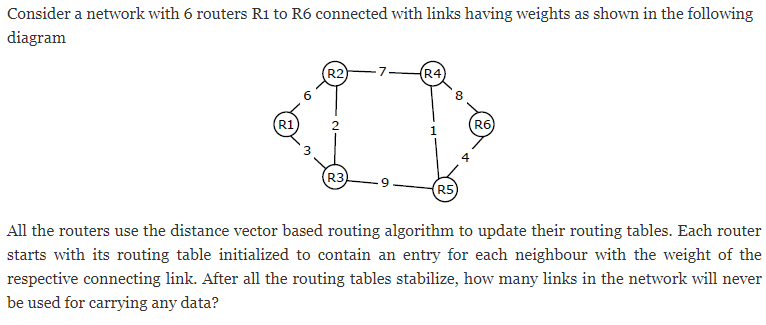
Consider a network with 6 routers R1 to R6 connected with links having weights as shown in the following diagram: All the routers use the distance vector based routing algorithm to update their routing tables. Each router starts with its routing table initialized to contain an entry for each neighbour with the weight of the respective connecting link. After all the routing tables stabilize, how many links in the network will never be used for carrying any data?
| A | 0 |
| B | 1 |
| C | 2 |
| D | 4 |
Computer-Networks Routing 2010
| Question 87 |
In the RSA public key cryptosystem, the private and public keys are (e,n) and (d,n) respectively, where n=p*q and p and q are large primes. Besides, n is public and p and q are private. Let M be an integer such Which of the above equations correctly represent RSA cryptosystem?
| A | I and II |
| B | I and III |
| C | II and IV |
| D | III and IV |
Computer-Networks Network-Security 2009
| Question 88 |
While opening a TCP connection, the initial sequence number is to be derived using a time-of-day (ToD) clock that keeps running even when the host is down. The low order 32 bits of the counter of the ToD clock is to be used for the initial sequence numbers. The clock counter increments once per millisecond. The maximum packet lifetime is given to be Which one of the choices given below is closest to the minimum permissible rate at which sequence numbers used for packets of a connection can increase?
| A | 0.015/s |
| B | 0.064/s |
| C | 0.135/s |
| D | 0.327/s |
Computer-Networks TCP 2009
| Question 89 |
Let G(x) be the generator polynomial used for CRC checking. What is the condition that should be satisfied by G(x) to detect odd number of bits in error?
| A | G(x) contains more than two terms |
| B | G(x) does not divide 1+xk, for any k not exceeding the frame length |
| C | 1+x is a factor of G(x) |
| D | G(x) has an odd number of terms |
Computer-Networks Error-Detection 2009
| Question 90 |
Frames of 1000 bits are sent over a 106 bps duplex link between two hosts. The propagation time is 25ms. Frames are to be transmitted into this link to maximally pack them in transit (within the link). What is the minimum number of bits (l) that will be required to represent the sequence numbers distinctly? Assume that no time gap needs to be given between transmission of two frames.
| A | I = 2 |
| B | I = 3 |
| C | I = 4 |
| D | I = 5 |
Computer-Networks Sliding-Window-Protocol 2009
| Question 91 |
Frames of 1000 bits are sent over a 106 bps duplex link between two hosts. The propagation time is 25ms. Frames are to be transmitted into this link to maximally pack them in transit (within the link).
Suppose that the sliding window protocol is used with the sender window size of 2l, where l is the number of bits identified in the earlier part and acknowledgements are always piggy backed. After sending 2l frames, what is the minimum time the sender will have to wait before starting transmission of the next frame? (Identify the closest choice ignoring the frame processing time.)
| A | 16ms |
| B | 18ms |
| C | 20ms |
| D | 22ms |
Computer-Networks Sliding-Window-Protocol 2009
| Question 92 |
What is the maximum size of data that the application layer can pass on to the TCP layer below?
| A | Any size |
| B | 216 bytes-size of TCP header |
| C | 216 bytes |
| D | 1500 bytes |
Computer-Networks Application-Layer-Protocol Gate-2008
| Question 93 |
Which of the following system calls results in the sending of SYN packets?
| A | socket |
| B | bind |
| C | listen |
| D | connect |
Computer-Networks Sockets Gate-2008
| Question 94 |
In the slow start phase of the TCP congestion control algorithm, the size of the congestion window
| A | does not increase |
| B | increases linearly |
| C | increases quadratically |
| D | increases exponentially |
Computer-Networks TCP Gate-2008
| Question 95 |
If a class B network on the Internet has a subnet mask of 255.255.248.0, what is the maximum number of hosts per subnet?
| A | 1022 |
| B | 1023 |
| C | 2046 |
| D | 2047 |
Computer-Networks IP-Address Gate-2008
| Question 96 |
A computer on a 10Mbps network is regulated by a token bucket. The token bucket is filled at a rate of 2Mbps. It is initially filled to capacity with 16Megabits. What is the maximum duration for which the computer can transmit at the full 10Mbps?
| A | 1.6 seconds |
| B | 2 seconds |
| C | 5 seconds |
| D | 8 seconds |
Computer-Networks Token-Bucket Gate-2008
| Question 97 |
A client process P needs to make a TCP connection to a server process S. Consider the following situation: the server process S executes a socket (), a bind () and a listen () system call in that order, following which it is preempted. Subsequently, the client process P executes a socket () system call followed by connect () system call to connect to the server process S. The server process has not executed any accept() system call. Which one of the following events could take place?
| A | connect ( ) system call returns successfully |
| B | connect ( ) system call blocks |
| C | connect ( ) system call returns an error |
| D | connect ( ) system call results in a core dump |
Computer-Networks Sockets Gate-2008
| Question 98 |
Provider the best matching between the entries in the two columns given in the table below:
| A | I-a, II-d, III-c, IV-b |
| B | I-b, II-d, III-c, IV-a |
| C | I-a, II-c, III-d, IV-b |
| D | I-b, II-c, III-d, IV-a |
Computer-Networks Match-the-Following Gate 2008-IT
| Question 99 |
A 1Mbps satellite link connects two ground stations. The altitude of the satellite is 36,504 km and speed of the signal is 3 × 10⁸ m/s. What should be the packet size for a channel utilization of 25% for a satellite link using go-back-127 sliding window protocol? Assume that the acknowledgment packets are negligible in size and that there are no errors during communication.
| A | 120 bytes |
| B | 60 bytes |
| C | 240 bytes |
| D | 90 bytes |
Computer-Networks Sliding-Window-Protocol Gate 2008-IT
| Question 100 |
The minimum frame size required for a CSMA/CD based computer network running at 1 Gbps on a 200 m cable with a link speed of 2 × 10⁸ m/s is
| A | 125 bytes |
| B | 250 bytes |
| C | 500 bytes |
| D | None of these |
Computer-Networks Ethernet Gate 2008-IT
| Question 101 |
Data transmitted on a link uses the following 2D parity scheme for error detection: Each sequence of 28 bits is arranged in a 4×7 matrix (rows r0 through r3, and columns d7 through d1) and is padded with a column d0 and row r4 of parity bits computed using the Even parity scheme. Each bit of column d0 (respectively, row r4) gives the parity of the corresponding row (respectively, column). These 40 bits are transmitted over the data link. The table shows data received by a receiver and has n corrupted bits. What is the minimum possible value of n?
| A | 1 |
| B | 2 |
| C | 3 |
| D | 4 |
Computer-Networks Error-Detection Gate 2008-IT
| Question 102 |
Two popular routing algorithms are Distance Vector(DV) and Link State (LS) routing. Which of the following are true? (S1) Count to infinity is a problem only with DV and not LS routing (S2) In LS, the shortest path algorithm is run only at one node (S3) In DV, the shortest path algorithm is run only at one node (S4) DV requires lesser number of network messages than LS
| A | S1, S2 and S4 only |
| B | S1, S3 and S4 only |
| C | S2 and S3 only |
| D | S1 and S4 only |
Computer-Networks Routing Gate 2008-IT
| Question 103 |
Which of the following statements are TRUE? (S1) TCP handles both congestion and flow control (S2) UDP handles congestion but not flow control (S3) Fast retransmit deals with congestion but not flow control (S4) Slow start mechanism deals with both congestion and flow control
| A | S1, S2 and S3 only |
| B | S1 and S3 only |
| C | S3 and S4 only |
| D | S1, S3 and S4 only |
Computer-Networks Congestion-Control Gate 2008-IT
| Question 104 |
The three way handshake for TCP connection establishment is shown below. Which of the following statements are TRUE? (S1) Loss of SYN + ACK from the server will not establish a connection (S2) Loss of ACK from the client cannot establish the connection (S3) The server moves LISTEN → SYN_RCVD → SYN_SENT → ESTABLISHED in the state machine on no packet loss (S4) The server moves LISTEN → SYN_RCVD → ESTABLISHED in the state machine on no packet loss.
| A | S2 and S3 only |
| B | S1 and S4 |
| C | S1 and S3 |
| D | S2 and S4 |
Computer-Networks TCP Gate 2008-IT
| Question 105 |
The total number of keys required for a set of n individuals to be able to communicate with each other using secret key and public key crypto-systems, respectively are:
| A | |
| B | |
| C | |
| D |
Computer-Networks Network-Security Gate 2008-IT
| Question 106 |
Host X has IP address 192.168.1.97 and is connected through two routers R1 and R2 to another host Y with IP address 192.168.1.80. Router R1 has IP addresses 192.168.1.135 and 192.168.1.110. R2 has IP addresses 192.168.1.67 and 192.168.1.155. The netmask used in the network is 255.255.255.224. Given the information above, how many distinct subnets are guaranteed to already exist in the network?
| A | 1 |
| B | 2 |
| C | 3 |
| D | 6 |
Computer-Networks IP-Address Gate 2008-IT
| Question 107 |
Host X has IP address 192.168.1.97 and is connected through two routers R1 and R2 to another host Y with IP address 192.168.1.80. Router R1 has IP addresses 192.168.1.135 and 192.168.1.110. R2 has IP addresses 192.168.1.67 and 192.168.1.155. The netmask used in the network is 255.255.255.224. Which IP address should X configure its gateway as?
| A | 192.168.1.67 |
| B | 192.168.1.110 |
| C | 192.168.1.135 |
| D | 192.168.1.155 |
Computer-Networks IP-Address Gate 2008-IT
| Question 108 |
In Ethernet when Manchester encoding is used, the bit rate is:
| A | Half the baud rate. |
| B | Twice the baud rate. |
| C | Same as the baud rate. |
| D | None of the above. |
Computer-Networks Ethernet Gate-2007
| Question 109 |
Which one of the following uses UDP as the transport protocol?
| A | HTTP |
| B | Telnet |
| C | DNS |
| D | SMTP |
Computer-Networks Transport Layer Protocol Gate-2007
| Question 110 |
There are n stations in a slotted LAN. Each station attempts to transmit with a probability p in each time slot. What is the probability that ONLY one station transmits in a given time slot?
| A | np(1-p)n-1 |
| B | (1-p)n-1 |
| C | p(1-p)n-1 |
| D | 1-(1-p)n-1 |
Computer-Networks LAN-and-Probability Gate-2007
| Question 111 |
In a token ring network the transmission speed is 107 bps and the propagation speed is 200 metres/μs. The 1-bit delay in this network is equivalent to:
| A | 500 metres of cable. |
| B | 200 metres of cable. |
| C | 20 metres of cable. |
| D | 50 metres of cable. |
Computer-Networks Token-Ring-Network Gate-2007
| Question 112 |
The address of a class B host is to be split into subnets with a 6-bit subnet number. What is the maximum number of subnets and the maximum number of hosts in each subnet?
| A | 62 subnets and 262142 hosts. |
| B | 64 subnets and 262142 hosts. |
| C | 62 subnets and 1022 hosts. |
| D | 64 subnets and 1024 hosts. |
Computer-Networks IP-Address Gate-2007
| Question 113 |
The message 11001001 is to be transmitted using the CRC polynomial x3+1 to protect it from errors. The message that should be transmitted is:
| A | 11001001000 |
| B | 11001001011 |
| C | 11001010 |
| D | 110010010011 |
Computer-Networks CRC Gate-2007
| Question 114 |
The distance between two stations M and N is L kilometers. All frames are K bits long. The propagation delay per kilometer is t seconds. Let R bits/second be the channel capacity. Assuming that processing delay is negligible, the minimum number of bits for the sequence number field in a frame for maximum utilization, when the sliding window protocol is used, is:
| A | ⌈log2(2LtR+2K/K)⌉ |
| B | ⌈log2(2LtR/K)⌉ |
| C | ⌈log2(2LtR+K/K)⌉ |
| D | ⌈log2(2LtR+K/2K)⌉ |
Computer-Networks Sliding-Window-Protocol Gate-2007
| Question 115 |
Match the following:
(P) SMTP (1) Application layer
(Q) BGP (2) Transport layer
(R) TCP (3) Data link layer
(S) PPP (4) Network layer
(5) Physical layer
| A | P – 2 Q – 1 R – 3 S – 5 |
| B | P – 1 Q – 4 R – 2 S – 3 |
| C | P – 1 Q – 4 R – 2 S – 5 |
| D | P – 2 Q – 4 R – 1 S – 3 |
Computer-Networks Match-the-Following Gate-2007
| Question 116 |
Consider the following statements about the timeout value used in TCP. i. The timeout value is set to the RTT (Round Trip Time) measured during TCP connection establishment for the entire duration of the connection. ii. Appropriate RTT estimation algorithm is used to set the timeout value of a TCP connection. iii. Timeout value is set to twice the propagation delay from the sender to the receiver. Which of the following choices hold?
| A | (i) is false, but (ii) and (iii) are true |
| B | (i) and (iii) are false, but (ii) is title |
| C | (i) and (ii) are false, but (iii) is true |
| D | (i), (ii) and (iii) are false |
Computer-Networks TCP Gate 2007-IT
| Question 117 |
Consider a TCP connection in a state where there are no outstanding ACKs. The sender sends two segments back to back. The sequence numbers of the first and second segments are 230 and 290 respectively. The first segment was lost, but the second segment was received correctly by the receiver. Let X be the amount of data carried in the first segment (in bytes), and Y be the ACK number sent by the receiver. The values of X and Y (in that order) are
| A | 60 and 290 |
| B | 230 and 291 |
| C | 60 and 231 |
| D | 60 and 230 |
Computer-Networks TCP Gate 2007-IT
| Question 118 |
Consider the following two statements: i. A hash function (these are often used for computing digital signatures) is an injective function. A. encryption technique such as DES performs a permutation on the elements of its input alphabet. Which one of the following options is valid for the above two statements?
| A | Both are false |
| B | Statement (i) is true and the other is false |
| C | Statement (ii) is true and the other is false |
| D | Both are true |
Computer-Networks Network-Security Gate 2007-IT
| Question 119 |
A firewall is to be configured to allow hosts in a private network to freely open TCP connections and send packets on open connections. However, it will only allow external hosts to send packets on existing open TCP connections or connections that are being opened (by internal hosts) but not allow them to open TCP connections to hosts in the private network. To achieve this the minimum capability of the firewall should be that of
| A | A combinational circuit |
| B | A finite automaton |
| C | A pushdown automaton with one stack |
| D | A pushdown automaton with two stacks |
Computer-Networks TCP Gate 2007-IT
| Question 120 |
An error correcting code has the following code words: 00000000, 00001111, 01010101, 10101010, 11110000. What is the maximum number of bit errors that can be corrected ?
| A | 0 |
| B | 1 |
| C | 2 |
| D | 3 |
Computer-Networks Error-Correction Gate 2007-IT
| Question 121 |
For the network given in the figure below, the routing tables of the four nodes A, E, D and G are shown. Suppose that F has estimated its delay to its neighbors, A, E, D and G as 8, 10, 12 and 6 msecs respectively and updates its routing table using distance vector routing technique.
| A | |
| B | |
| C | |
| D |
Computer-Networks Routing Gate 2007-IT
| Question 122 |
In the waveform (a) given below, a bit stream is encoded by Manchester encoding scheme. The same bit stream is encoded in a different coding scheme in wave form (b). The bit stream and the coding scheme are
| A | 1000010111 and Differential Manchester respectively |
| B | 0111101000 and Differential Manchester respectively |
| C | 1000010111 and Integral Manchester respectively |
| D | 0111101000 and Integral Manchester respectively |
Computer-Networks Manchester-Encoding Gate 2007-IT
| Question 123 |
Let us consider a statistical time division multiplexing of packets. The number of sources is 10. In a time unit, a source transmits a packet of 1000 bits. The number of sources sending data for the first 20 time units is 6, 9, 3, 7, 2, 2, 2, 3, 4, 6, 1, 10, 7, 5, 8, 3, 6, 2, 9, 5 respectively. The output capacity of multiplexer is 5000 bits per time unit. Then the average number of backlogged of packets per time unit during the given period is
| A | 5 |
| B | 4.45 |
| C | 3.45 |
| D | 0 |
Computer-Networks Access-Control-Methods Gate 2007-IT
| Question 124 |
A group of 15 routers are interconnected in a centralized complete binary tree with a router at each tree node. Router j communicates with router j by sending a message to the root of the tree. The root then sends the message back down to router j. The mean number of hops per message, assuming all possible router pairs are equally likely is
| A | 3 |
| B | 4.26 |
| C | 4.53 |
| D | 5.26 |
Computer-Networks Routing Gate 2007-IT
| Question 125 |
A broadcast channel has 10 nodes and total capacity of 10 Mbps. It uses polling for medium access. Once a node finishes transmission, there is a polling delay of 80 μs to poll the next node. Whenever a node is polled, it is allowed to transmit a maximum of 1000 bytes. The maximum throughput of the broadcast channel is
| A | 1 Mbps |
| B | 100/11 Mbps |
| C | 10 Mbps |
| D | 100 Mbps |
Computer-Networks Access-Control-Methods Gate 2007-IT
| Question 126 |
Consider the following clauses: i. Not inherently suitable for client authentication. ii. Not a state sensitive protocol. iii. Must be operated with more than one server. iv. Suitable for structured message organization. v. May need two ports on the serve side for proper operation. The option that has the maximum number of correct matches is
| A | IMAP-(i), FTP-(ii), HTTP-(iii), DNS-(iv), POP3-(v) |
| B | FTP-(i), POP3-(ii), SMTP-(iii), HTTP-(iv), IMAP-(v) |
| C | POP3-(i), SMTP-(ii), DNS-(iii), IMAP-(iv), HTTP-(v) |
| D | SMTP-(i), HTTP-(ii), IMAP-(iii), DNS-(iv), FTP-(v) |
Computer-Networks Network-Protocols Gate 2007-IT
| Question 127 |
Your are given the following four bytes : 10100011 00110111 11101001 10101011 Which of the following are substrings of the base 64 encoding of the above four bytes ?
| A | zdp |
| B | fpq |
| C | qwA |
| D | oze |
Computer-Networks Network-Security Gate 2007-IT
| Question 128 |
Consider a token ring topology with N stations (numbered 1 to N) running token ring protocol where the stations are equally spaced. When a station gets the token it is allowed to send one frame of fixed size. Ring latency is tp, while the transmission time of a frame is tt. All other latencies can be neglected. The maximum utilization of the token ring when tt =3 ms, tp = 5 ms, N = 10 is
| A | 0.545 |
| B | 0.6 |
| C | 0.857 |
| D | 0.961 |
Computer-Networks Token-Ring-Topology Gate 2007-IT
| Question 129 |
Consider a token ring topology with N stations (numbered 1 to N) running token ring protocol where the stations are equally spaced. When a station gets the token it is allowed to send one frame of fixed size. Ring latency is tp, while the transmission time of a frame is tt. All other latencies can be neglected. The maximum utilization of the token ring when tt = 5 ms, tp = 3 ms, N = 15 is :
| A | 0.545 |
| B | 0.655 |
| C | 0.9375 |
| D | 0.961 |
Computer-Networks Token Ring Topology Gate 2007-IT
| Question 130 |
For which one of the following reasons does Internet Protocol (IP) use the time-to- live (TTL) field in the IP datagram header?
| A | Ensure packets reach destination within that time |
| B | Discard packets that reach later than that time |
| C | Prevent packets from looping indefinitely |
| D | Limit the time for which a packet gets queued in intermediate routers |
Computer-Networks IP-Header Gate-2006
| Question 131 |
Consider the diagram shown below where a number of LANs are connected by (transparent) bridges. In order to avoid packets looping through circuits in the graph, the bridges organize themselves in a spanning tree. First, the root bridge is identified as the bridge with the least serial number. Next, the root sends out (one or more) data units to enable the setting up of the spanning tree of shortest paths from the root bridge to each bridge. Each bridge identifies a port (the root port) through which it will forward frames to the root bridge. Port conflicts are always resolved in favour of the port with the lower index value. When there is a possibility of multiple bridges forwarding to the same LAN (but not through the root port), ties are broken as follows: bridges closest to the root get preference and between such bridges, the one with the lowest serial number is preferred. For the given connection of LANs by bridges, which one of the following choices represents the depth first traversal of the spanning tree of bridges?
| A | |
| B | |
| C | |
| D |
Computer-Networks Bridges Gate-2006
| Question 132 |
Consider the diagram shown below where a number of LANs are connected by (transparent) bridges. In order to avoid packets looping through circuits in the graph, the bridges organize themselves in a spanning tree. First, the root bridge is identified as the bridge with the least serial number. Next, the root sends out (one or more) data units to enable the setting up of the spanning tree of shortest paths from the root bridge to each bridge. Each bridge identifies a port (the root port) through which it will forward frames to the root bridge. Port conflicts are always resolved in favour of the port with the lower index value. When there is a possibility of multiple bridges forwarding to the same LAN (but not through the root port), ties are broken as follows: bridges closest to the root get preference and between such bridges, the one with the lowest serial number is preferred. For the given connection of LANs by bridges, which one of the following choices represents the depth first traversal of the spanning tree of bridges?
| A | B1, B5, B3, B4, B2 |
| B | B1, B3, B5, B2, B4 |
| C | B1, B5, B2, B3, B4 |
| D | B1, B3, B4, B5, B2 |
Computer-Networks Bridges Gate-2006
| Question 133 |
Station A needs to send a message consisting of 9 packets to Station B using a sliding window (window size 3) and go-back-n error control strategy. All packets are ready and immediately available for transmission. If every 5th packet that A transmits gets lost (but no acks from B ever get lost), then what is the number of packets that A will transmit for sending the message to B?
| A | 12 |
| B | 14 |
| C | 16 |
| D | 18 |
Computer-Networks Sliding-Window-Protocol Gate-2006
| Question 134 |
Station A uses 32 byte packets to transmit messages to Station B using a sliding window protocol. The round trip delay between A and B is 80 milliseconds and the bottleneck bandwidth on the path between A and B is 128 kbps. What is the optimal window size that A should use?
| A | 20 |
| B | 40 |
| C | 160 |
| D | 320 |
Computer-Networks Sliding-Window-Protocol Gate-2006
| Question 135 |
Two computers C1 and C2 are configured as follows. C1 has IP address 203.197.2.53 and netmask 255.255.128.0. C2 has IP address 203.197.75.201 and netmask 255.255.192.0. Which one of the following statements is true?
| A | C1 and C2 both assume they are on the same network |
| B | C2 assumes C1 is on same network, but C1 assumes C2 is on a different network |
| C | C1 assumes C2 is on same network, but C2 assumes C1 is on a different network |
| D | C1 and C2 both assume they are on different networks |
Computer-Networks IP-Address Gate-2006
| Question 136 |
HELO and PORT, respectively, are commands from the protocols
| A | FTP and HTTP |
| B | TELNET and POP3 |
| C | HTTP and TELNET |
| D | SMTP and FTP |
Computer-Networks Network-Protocols Gate 2006-IT
| Question 137 |
Which of the following statements is TRUE?
| A | Both Ethernet frame and IP packet include checksum fields |
| B | Ethernet frame includes a checksum field and IP packet includes a CRC field |
| C | Ethernet frame includes a CRC field and IP packet includes a checksum field |
| D | Both Ethernet frame and IP packet include CRC fields |
Computer-Networks Ethernet Gate 2006-IT
| Question 138 |
Which of the following statement(s) is TRUE?
- A hash function takes a message of arbitrary length and generates a fixed length code.
- A hash function takes a message of fixed length and generates a code of variable length.
- A hash function may give the same hash value for distinct messages.
| A | 1 only |
| B | 2 and 3 only |
| C | 1 and 3 only |
| D | 2 only |
Computer-Networks Network-Security Gate 2006-IT
| Question 139 |
A router uses the following routing table: A packet bearing a destination address 144.16.68.117 arrives at the router. On which interface will it be forwarded?
| A | eth0 |
| B | eth1 |
| C | eth2 |
| D | eth3 |
Computer-Networks IP-Address Gate 2006-IT
| Question 140 |
Suppose that it takes 1 unit of time to transmit a packet (of fixed size) on a communication link. The link layer uses a window flow control protocol with a window size of N packets. Each packet causes an ack or a nak to be generated by the receiver, and ack/nak transmission times are negligible. Further, the round trip time on the link is equal to N units. Consider time i > N. If only acks have been received till time i(no naks), then the goodput evaluated at the transmitter at time i(in packets per unit time) is
| A | 1 – N/i |
| B | i/(N + i) |
| C | 1 |
| D | 1 – e(i/N) |
Computer-Networks Sliding-Window-Protocol Gate 2006-IT
| Question 141 |
In the 4B/5B encoding scheme, every 4 bits of data are encoded in a 5-bit codeword. It is required that the codewords have at most 1 leading and at most 1 trailing zero. How many such codewords are possible?
| A | 14 |
| B | 16 |
| C | 18 |
| D | 20 |
Computer-Networks Encoding Gate 2006-IT
| Question 142 |
A router has two full-duplex Ethernet interfaces each operating at 100 Mb/s. Ethernet frames are at least 84 bytes long (including the Preamble and the Inter-Packet-Gap). The maximum packet processing time at the router for wirespeed forwarding to be possible is (in microseconds)
| A | 0.01 |
| B | 3.36 |
| C | 6.72 |
| D | 8 |
Computer-Networks Ethernet Gate 2006-IT
| Question 143 |
A link of capacity 100 Mbps is carrying traffic from a number of sources. Each source generates an on-off traffic stream; when the source is on, the rate of traffic is 10 Mbps, and when the source is off, the rate of traffic is zero. The duty cycle, which is the ratio of on-time to off-time, is 1:2. When there is no buffer at the link, the minimum number of sources that can be multiplexed on the link so that link capacity is not wasted and no data loss occurs is S1. Assuming that all sources are synchronized and that the link is provided with a large buffer, the maximum number of sources that can be multiplexed so that no data loss occurs is S2. The values of S1 and S2 are, respectively,
| A | 10 and 30 |
| B | 12 and 25 |
| C | 5 and 33 |
| D | 15 and 22 |
Computer-Networks Network-Layer Gate 2006-IT
| Question 144 |
On a wireless link, the probability of packet error is 0.2. A stop-and-wait protocol is used to transfer data across the link. The channel condition is assumed to be independent from transmission to transmission. What is the average number of transmission attempts required to transfer 100 packets?
| A | 100 |
| B | 125 |
| C | 150 |
| D | 200 |
Computer-Networks Stop-and-Wait-protocol Gate 2006-IT
| Question 145 |
A program on machine X attempts to open a UDP connection to port 5376 on a machine Y, and a TCP connection to port 8632 on machine Z. However, there are no applications listening at the corresponding ports on Y and Z. An ICMP Port Unreachable error will be generated by
| A | Y but not Z |
| B | Z but not Y |
| C | Neither Y nor Z |
| D | Both Y and Z |
Computer-Networks TCP-and-UDP Gate 2006-IT
| Question 146 |
A subnetted Class B network has the following broadcase address : 144.16.95.255. Its subnet mask
| A | is necessarily 255.255.224.0 |
| B | is necessarily 255.255.240.0 |
| C | is necessarily 255.255.248.0 |
| D | could be any one of 255.255.224.0, 255.255.240.0, 255.255.248.0 |
Computer-Networks IP-Address Gate 2006-IT
| Question 147 |
Let E1 and E2 be two entities in an E/R diagram with simple single-valued attributes. R1 and R2 are two relationships between E1 and E2, where R1 is one-to-many and R2 is many-to-many. R1 and R2 do not have any attributes of their own. What is the minimum number of tables required to represent this situation in the relational model?
| A | 2 |
| B | 3 |
| C | 4 |
| D | 5 |
Computer-Networks ER-Model Gate-2005
| Question 148 |
In a packet switching network, packets are routed from source to destination along a single path having two intermediate nodes. If the message size is 24 bytes and each packet contains a header of 3 bytes, then the optimum packet size is:
| A | 4 |
| B | 6 |
| C | 7 |
| D | 9 |
Computer-Networks Network-Switching Gate-2005
| Question 149 |
Suppose the round trip propagation delay for a 10 Mbps Ethernet having 48-bit jamming signal is 46.4 μs. The minimum frame size is:
| A | 94 |
| B | 416 |
| C | 464 |
| D | 512 |
Computer-Networks Ethernet Gate-2005
| Question 150 |
The maximum window size for data transmission using the selective reject protocol with n-bit frame sequence numbers is:
| A | 2n |
| B | 2n-1 |
| C | 2n – 1 |
| D | 2n-2 |
Computer-Networks Sliding-Window-Protocol Gate-2005
| Question 151 |
In a network of LANs connected by bridges, packets are sent from one LAN to another through intermediate bridges. Since more than one path may exist between two LANs, packets may have to be routed through multiple bridges. Why is the spanning tree algorithm used for bridge-routing?
| A | For shortest path routing between LANs |
| B | For avoiding loops in the routing paths |
| C | For fault tolerance |
| D | For minimizing collisions |
Computer-Networks Bridges Gate-2005
| Question 152 |
An organization has a class B network and wishes to form subnets for 64 departments. The subnet mask would be:
| A | 255.255.0.0 |
| B | 255.255.64.0 |
| C | 255.255.128.0 |
| D | 255.255.252.0 |
Computer-Networks IP-Address Gate-2005
| Question 153 |
Packets of the same session may be routed through different paths in:
| A | TCP, but not UDP |
| B | TCP and UDP |
| C | UDP, but not TCP |
| D | Neither TCP nor UDP |
Computer-Networks Routing Gate-2005
| Question 154 |
The address resolution protocol (ARP) is used for:
| A | Finding the IP address from the DNS |
| B | Finding the IP address of the default gateway |
| C | Finding the IP address that corresponds to a MAC address |
| D | Finding the MAC address that corresponds to an IP address |
Computer-Networks Network-Addressing Gate-2005
| Question 155 |
Traceroute reports a possible route that is taken by packets moving from some host A to some other host B. Which of the following options represents the technique used by traceroute to identify these hosts
| A | By progressively querying routers about the next router on the path to B using ICMP packets, starting with the first router |
| B | By requiring each router to append the address to the ICMP packet as it is forwarded to B. The list of all routers en-route to B is returned by B in an ICMP reply packet |
| C | By ensuring that an ICMP reply packet is returned to A by each router en-route to B, in the ascending order of their hop distance from A |
| D | By locally computing the shortest path from A to B |
Computer-Networks Network-Layer Gate 2005-IT
| Question 156 |
Which of the following statements is TRUE about CSMA/CD
| A | IEEE 802.11 wireless LAN runs CSMA/CD protocol |
| B | Ethernet is not based on CSMA/CD protocol |
| C | CSMA/CD is not suitable for a high propagation delay network like satellite network |
| D | There is no contention in a CSMA/CD network |
Computer-Networks CSMA/CD Gate 2005-IT
| Question 157 |
Which of the following statements is FALSE regarding a bridge?
| A | Bridge is a layer 2 device |
| B | Bridge reduces collision domain |
| C | Bridge is used to connect two or more LAN segments |
| D | Bridge reduces broadcast domain |
Computer-Networks Network-Layer Gate 2005-IT
| Question 158 |
Count to infinity is a problem associated with
| A | link state routing protocol. |
| B | distance vector routing protocol. |
| C | DNS while resolving host name. |
| D | TCP for congestion control. |
Computer-Networks Network-Layer Gate 2005-IT
| Question 159 |
A network with CSMA/CD protocol in the MAC layer is running at 1 Gbps over a 1 km cable with no repeaters. The signal speed in the cable is 2 × 10⁸ m/sec. The minimum frame size for this network should be
| A | 10000 bits |
| B | 10000 bytes |
| C | 5000 bits |
| D | 5000 bytes |
Computer-Networks CSMA/CD Gate 2005-IT
| Question 160 |
A channel has a bit rate of 4 kbps and one-way propagation delay of 20 ms. The channel uses stop and wait protocol. The transmission time of the acknowledgement frame is negligible. To get a channel efficiency of at least 50%, the minimum frame size should be
| A | 80 bytes |
| B | 80 bits |
| C | 160 bytes |
| D | 160 bits |
Computer-Networks Data-Link-Layer Gate 2005-IT
| Question 161 |
On a TCP connection, current congestion window size is Congestion Window=4 KB. The window size advertised by the receiver is Advertise Window=6 KB. The last byte sent by the sender is LastByteSent=10240 and the last byte acknowledged by the receiver is LastByteAcked=8192. The current window size at the sender is
| A | 2048 bytes |
| B | 4096 bytes |
| C | 6144 bytes |
| D | 8192 bytes |
Computer-Networks Transport Layer Gate 2005-IT
| Question 162 |
In a communication network, a packet of length L bits takes link L1 with a probability of p1 or link L2 with a probability of p2. Link L1 and L2 have bit error probability of b1and b2 respectively. The probability that the packet will be received without error via either L1 or L2 is
| A | (1 – b1)L p1 + (1 – b2)Lp2 |
| B | [1 – (b1 + b2)L]p1p2 |
| C | (1 – b1)L (1 – b2)Lp1p2 |
| D | 1 – (b1 Lp1 + b2 Lp2) |
Computer-Networks Network-Layer Gate 2005-IT
| Question 163 |
In a TDM medium access control bus LAN, each station is assigned one time slot per cycle for transmission. Assume that the length of each time slot is the time to transmit 100 bits plus the end-to-end propagation delay. Assume a propagation speed of 2 × 10⁸ m/sec. The length of the LAN is 1 km with a bandwidth of 10 Mbps. The maximum number of stations that can be allowed in the LAN so that the throughput of each station can be 2/3 Mbps is
| A | 3 |
| B | 5 |
| C | 10 |
| D | 20 |
Computer-Networks Data-Link-Layer Gate 2005-IT
| Question 164 |
A company has a class C network address of 204.204.204.0. It wishes to have three subnets, one with 100 hosts and two with 50 hosts each. Which one of the following options represents a feasible set of subnet address/subnet mask pairs?
| A | 204.204.204.128/255.255.255.192 204.204.204.0/255.255.255.128 204.204.204.64/255.255.255.128 |
| B | 204.204.204.0/255.255.255.192 204.204.204.192/255.255.255.128 204.204.204.64/255.255.255.128 |
| C | 204.204.204.128/255.255.255.128 204.204.204.192/255.255.255.192 204.204.204.224/255.255.255.192 |
| D | 204.204.204.128/255.255.255.128 204.204.204.64/255.255.255.192 204.204.204.0/255.255.255.192 |
Computer-Networks Network-Layer Gate 2005-IT
| Question 165 |
Assume that “host1.mydomain.dom” has an IP address of 145.128.16.8. Which of the following options would be most appropriate as a subsequence of steps in performing the reverse lookup of 145.128.16.8? In the following options “NS” is an abbreviation of “nameserver”.
| A | Query a NS for the root domain and then NS for the “dom” domains |
| B | Directly query a NS for “dom” and then a NS for “mydomain.dom” domains |
| C | Query a NS for in-addr.arpa and then a NS for 128.145.in-addr.arpa domains |
| D | Directly query a NS for 145.in-addr.arpa and then a NS for 128.145.in-addr.arpa domains |
Computer-Networks Network-Layer Gate 2005-IT
| Question 166 |
Consider the following message M = 1010001101. The cyclic redundancy check (CRC) for this message using the divisor polynomial x5 + x4 + x2 + 1 is :
| A | 01110 |
| B | 01011 |
| C | 10101 |
| D | 10110 |
Computer-Networks Data-Link-Layer Gate 2005-IT
| Question 167 |
Suppose that two parties A and B wish to setup a common secret key (D-H key) between themselves using the Diffie-Hellman key exchange technique. They agree on 7 as the modulus and 3 as the primitive root. Party A chooses 2 and party B chooses 5 as their respective secrets. Their D-H key is
| A | 3 |
| B | 4 |
| C | 5 |
| D | 6 |
Computer-Networks Data-Link-Layer Gate 2005-IT
| Question 168 |
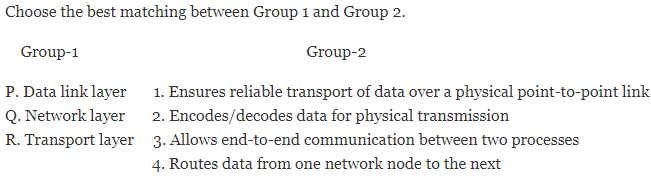

| A | P – 1, Q – 4, R – 3 |
| B | P – 2, Q – 4, R – 1 |
| C | P – 2, Q – 3, R – 1 |
| D | P – 1, Q – 3, R – 2 |
Computer-Networks Match-the-Following Gate-2004
| Question 169 |
Which of the following is NOT true with respect to a transparent bridge and a router?
| A | Both bridge and router selectively forward data packets |
| B | A bridge uses IP addresses while a router uses MAC addresses |
| C | A bridge builds up its routing table by inspecting incoming packets |
| D | A router can connect between a LAN and a WAN |
Computer-Networks Bridge-and-Router Gate-2004
| Question 170 |
How many 8-bit characters can be transmitted per second over a 9600 baud serial communication link using asynchronous mode of transmission with one start bit, eight data bits, two stop bits, and one parity bit?
| A | 600 |
| B | 800 |
| C | 876 |
| D | 1200 |
Computer-Networks Serial-Communication Gate-2004
| Question 171 |
A and B are the only two stations on an Ethernet. Each has a steady queue of frames to send. Both A and B attempt to transmit a frame, collide, and A wins the first backoff race. At the end of this successful transmission by A, both A and B attempt to transmit and collide. The probability that A wins the second backoff race is
| A | 0.5 |
| B | 0.625 |
| C | 0.75 |
| D | 1.0 |
Computer-Networks Ethernet Gate-2004
| Question 172 |
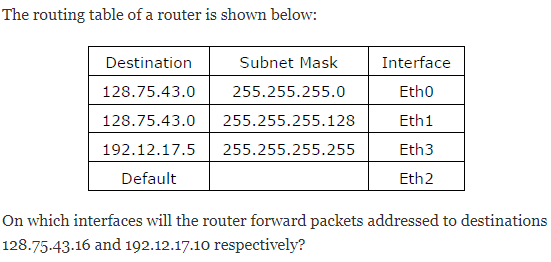

| A | Eth1 and Eth2 |
| B | Eth0 and Eth2 |
| C | Eth0 and Eth3 |
| D | Eth1 and Eth3 |
Computer-Networks IP-Address Gate-2004
| Question 173 |
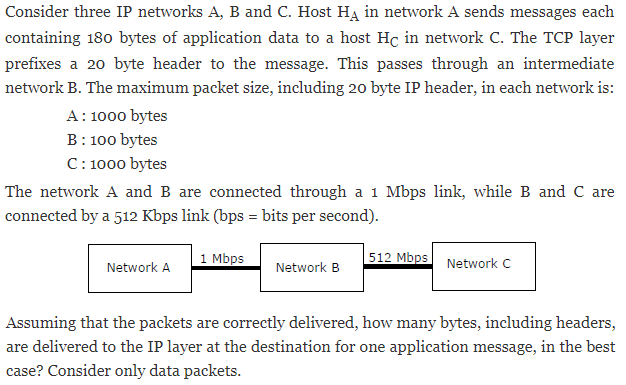

| A | 200 |
| B | 220 |
| C | 240 |
| D | 260 |
Computer-Networks IPv4-and-TCP Gate-2004
| Question 174 |
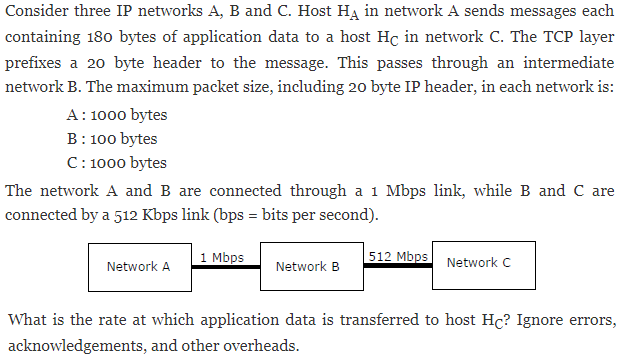

| A | 325.5 Kbps |
| B | 354.5 Kbps |
| C | 409.6 Kbps |
| D | 512.0 Kbps |
Computer-Networks IPv4-and-TCP Gate-2004
| Question 175 |
Which one of the following statements is FALSE?
| A | Packet switching leads to better utilization of bandwidth resources than circuit switching. |
| B | Packet switching results in less variation in delay than circuit switching. |
| C | Packet switching requires more per packet processing than circuit switching. |
| D | Packet switching can lead to reordering unlike in circuit switching. |
Computer-Networks Data-Link-Layer Gate 2004-IT
| Question 176 |
Which one of the following statements is FALSE?
| A | TCP guarantees a minimum communication rate |
| B | TCP ensures in-order delivery |
| C | TCP reacts to congestion by reducing sender window size |
| D | TCP employs retransmission to compensate for packet loss |
Computer-Networks General Gate 2004-IT
| Question 177 |
Which one of the following statements is FALSE?
| A | HTTP runs over TCP |
| B | HTTP describes the structure of web pages |
| C | HTTP allows information to be stored in a URL |
| D | HTTP can be used to test the validity of a hypertext link |
Computer-Networks General Gate 2004-IT
| Question 178 |
A sender is employing public key cryptography to send a secret message to a receiver. Which one of the following statements is TRUE?
| A | Sender encrypts using receiver’s public key |
| B | Sender encrypts using his own public key |
| C | Receiver decrypts using sender’s public key |
| D | Receiver decrypts using his own public key |
Computer-Networks Network-Security Gate 2004-IT
| Question 179 |
A subnet has been assigned a subnet mask of 255.255.255.192. What is the maximum number of hosts that can belong to this subnet?
| A | 14 |
| B | 30 |
| C | 62 |
| D | 126 |
Computer-Networks Network-Layer Gate 2004-IT
| Question 180 |
A host is connected to a Department network which is part of a University network. The University network, in turn, is part of the Internet. The largest network in which the Ethernet address of the host is unique is:
| A | the subnet to which the host belongs |
| B | the Department network |
| C | the University network |
| D | the Internet |
Computer-Networks Network-Layer Gate 2004-IT
| Question 181 |
In TCP, a unique sequence number is assigned to each
| A | byte |
| B | word |
| C | segment |
| D | message |
Computer-Networks Network-Layer Gate 2004-IT
| Question 182 |
Which of the following objects can be used in expressions and scriplets in JSP (Java Server Pages) without explicitly declaring them?
| A | session and request only |
| B | request and response only |
| C | response and session only |
| D | session, request and response |
Computer-Networks Network-Layer Gate 2004-IT
| Question 183 |
Consider the following statements: I. telnet, ftp and http are application layer protocols. II.l EJB (Enterprise Java Beans) components can be deployed in a J2EE (Java2 Enterprise Edition) application server. III. If two languages conform to the Common Language Specification (CLS) of the Microsoft.NET framework, then a class defined in any one of them may be inherited in the other. Which statements are true?
| A | l and II only |
| B | II and III only |
| C | l and III only |
| D | I, II and III |
Computer-Networks Application-Layer Gate 2004-IT
| Question 184 |
A serial transmission T1 uses 8 information bits, 2 start bits, 1 stop bit and 1 parity bit for each character. A synchronous transmission T2 uses 3 eight bit sync characters followed by 30 eight bit information characters. If the bit rate is 1200 bits/second in both cases, what are the transfer rates of T1 and T2?
| A | 100 characters/sec, 153 characters/sec |
| B | 80 characters/sec, 136 characters/sec |
| C | 100 characters/sec, 136 characters/sec |
| D | 80 characters/sec, 153 characters/sec |
Computer-Networks General Gate 2004-IT
| Question 185 |
In a sliding window ARQ scheme, the transmitter’s window size is N and the receiver’s window size is M. The minimum number of distinct sequence numbers required to ensure correct operation of the ARQ scheme is
| A | min (M,N) |
| B | max (M,N) |
| C | M + N |
| D | MN |
Computer-Networks ARQ-Protocol Gate 2004-IT
| Question 186 |
Consider a 10 Mbps token ring LAN with a ring latency of 400 µs. A host that needs to transmit seizes the token. Then it sends a frame of 1000 bytes, removes the frame after it has circulated all around the ring, and finally releases the token. This process is repeated for every frame. Assuming that only a single host wishes to transmit, the effective data rate is
| A | 1Mbps |
| B | 2Mbps |
| C | 5Mbps |
| D | 6Mbps |
Computer-Networks Network-Layer Gate 2004-IT
| Question 187 |
A 20 Kbps satellite link has a propagation delay of 400 ms. The transmitter employs the “go back n ARQ” scheme with n set to 10. Assuming that each frame is 100 bytes long, what is the maximum data rate possible?
| A | 5 Kbps |
| B | 10 Kbps |
| C | 15 Kbps |
| D | 20 Kbps |
Computer-Networks Network-Layer Gate 2004-IT
| Question 188 |
Consider a simplified time slotted MAC protocol, where each host always has data to send and transmits with probability p = 0.2 in every slot. There is no backoff and one frame can be transmitted in one slot. If more than one host transmits in the same slot, then the transmissions are unsuccessful due to collision. What is the maximum number of hosts which this protocol can support, if each host has to be provided a minimum through put of 0.16 frames per time slot?
| A | 1 |
| B | 2 |
| C | 3 |
| D | 4 |
Computer-Networks Data-Link-Layer Gate 2004-IT
| Question 189 |
In the TCP/IP protocol suite, which one of the following is NOT part of the IP header?
| A | Fragment Offset |
| B | Source IP address |
| C | Destination IP address |
| D | Destination port number |
Computer-Networks Network-Layer Gate 2004-IT
| Question 190 |
A TCP message consisting of 2100 bytes is passed to IP for delivery across two networks. The first network can carry a maximum payload of 1200 bytes per frame and the second network can carry a maximum payload of 400 bytes per frame, excluding network overhead. Assume that IP overhead per packet is 20 bytes. What is the total IP overhead in the second network for this transmission?
| A | 40 bytes |
| B | 80 bytes |
| C | 120 bytes |
| D | 160 bytes |
Computer-Networks Network-Layer Gate 2004-IT
| Question 191 |
Suppose that the maximum transmit window size for a TCP connection is 12000 bytes. Each packet consists of 2000 bytes. At some point of time, the connection is in slow-start phase with a current transmit window of 4000 bytes. Subsequently, the transmitter receives two acknowledgements. Assume that no packets are lost and there are no time-outs. What is the maximum possible value of the current transmit window?
| A | 4000 bytes |
| B | 8000 bytes |
| C | 10000 bytes |
| D | 12000 bytes |
Computer-Networks Network-Layer Gate 2004-IT
| Question 192 |
Which of the following assertions is FALSE about the Internet Protocol (IP)?
| A | It is possible for a computer to have multiple IP addresses |
| B | IP packets from the same source to the same destination can take different routes in the network |
| C | IP ensures that a packet is discarded if it is unable to reach its destination within a given number of hops |
| D | The packet source cannot set the route of an outgoing packets; the route is determined only by the routing tables in the routers on the way |
Computer-Networks IPv4 Gate-2003
| Question 193 |
Which of the following functionalities must be implemented by a transport protocol over and above the network protocol?
| A | Recovery from packet losses |
| B | Detection of duplicate packets |
| C | Packet delivery in the correct order |
| D | End to end connectivity |
Computer-Networks Transport Layer Protocol Gate-2003
| Question 194 |
The subnet mask for a particular network is 255.255.31.0. Which of the following pairs of IP addresses could belong to this network?
| A | 172.57.88.62 and 172.56.87.233 |
| B | 10.35.28.2 and 10.35.29.4 |
| C | 191.203.31.87 and 191.234.31.88 |
| D | 128.8.129.43 and 128.8.161.55 |
Computer-Networks IP-Address Gate-2003
| Question 195 |
A 2km long broadcast LAN has 107 bps bandwidth and uses CSMA/CD. The signal travels along the wire at 2×10⁸ m/s. What is the minimum packet size that can be used on this network?
| A | 50 bytes |
| B | 100 bytes |
| C | 200 bytes |
| D | None of the above |
Computer-Networks Ethernet Gate-2003
| Question 196 |
Host A is sending data to host B over a full duplex link. A and B are using the sliding window protocol for flow control. The send and receive window sizes are 5 packets each. Data packets (sent only from A to B) are all 1000 bytes long and the transmission time for such a packet is 50 µs Acknowledgement packets (sent only from B to A) are very small and require negligible transmission time. The propagation delay over the link is 200 µs. What is the maximum achievable throughput in this communication?
| A | 7.69 × 10⁶ bps |
| B | 11.11 × 10⁶ bps |
| C | 12.33 × 10⁶ bps |
| D | 15.00 × 10⁶ bps |
Computer-Networks Sliding-Window-Protocol Gate-2003
| Question 197 |
What is the distance of the following code 000000, 010101, 000111, 011001, 111111?
| A | 2 |
| B | 3 |
| C | 4 |
| D | 1 |
Computer-Networks Error-Detection Gate-1995
| Question 198 |
A simple and reliable data transfer can be accomplished by using the ‘handshake protocol’. It accomplishes reliable data transfer because for every data item sent by the transmitter __________.
| A | in this case receiver has to respond that receiver can be able to receive the data item. |
Computer-Networks Handshake-Protocol Gate-1992
| Question 199 |
Start and stop bits do not contain an ‘information’ but are used in serial communication for
| A | Error detection |
| B | Error correction |
| C | Synchronization |
| D | Slowing down the communications |
Computer-Networks Sequential-Circuits Gate-1992
| Question 200 |
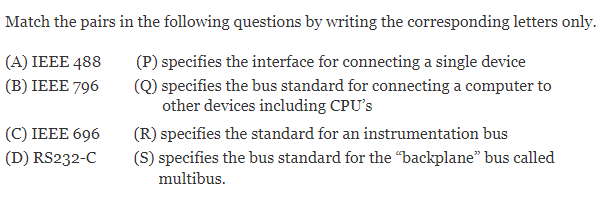

| A | Out of syllabus. |
Computer-Networks General Gate-1991